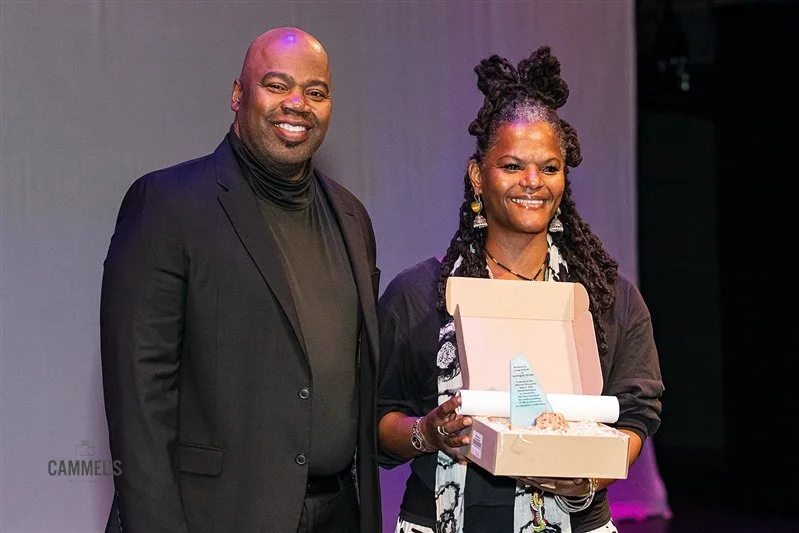
Recipient of the Richard A. Long Award (2026)
Dr. Hume was recently honored with the Richard A. Long Award for her outstanding research and creative practice advancing knowledge in Africana Dance. The award was presented by Dr. C. Kemal Nance, Executive Board member of The Collegium of African Diaspora Dance (CADD), during their conference at Duke University.This recognition marks a profound full-circle moment in Dr. Hume’s intellectual and creative journey. Nearly three decades ago, as a doctoral student at Emory University in Richard A. Long’s “Arts of the African Diaspora” course, she encountered a framework that affirmed Black expressive culture as a vital site of knowledge production. To now receive an award bearing his name is not only an academic honor, but a deeply personal and ancestral affirmation—one that speaks to continuity, mentorship, and the unfolding of a life dedicated to the sacred labor of dance.
Through both scholarship and creative work, Dr. Hume demonstrates how Africana movement traditions function as complex technologies of memory, ethics, and cosmology. In ritual dance, philosophy is enacted, ethics are rehearsed, and knowledge is transmitted through the disciplined intelligence of the body. Her work has evolved from the proscenium stage to site-specific, in situ engagements—spaces marked by historical and ancestral resonance. In these environments, dance becomes a means of activating memory embedded in land, water, and stone, and of unsettling the silences produced by colonial epistemologies. By centering the body as both instrument and archive, Dr. Hume creates pathways for Africana religious and cultural systems to be engaged not as static objects of study, but as dynamic, living philosophies.
This approach is further informed by her spiritual grounding and lineage-based practices, which shape her understanding of dance as “spirit work”—a disciplined process of alignment, humility, and relational accountability. Within this framework, movement becomes a site of negotiation between self, community, ancestry, and the divine. It is through this integrative lens that Dr. Hume has made significant contributions to both academic scholarship and creative practice, producing work that resonates across classrooms, performance spaces, and communities throughout the Caribbean and its diasporas. Learn more

“Embodied practice, the art of learning through experience and intercultural awareness”