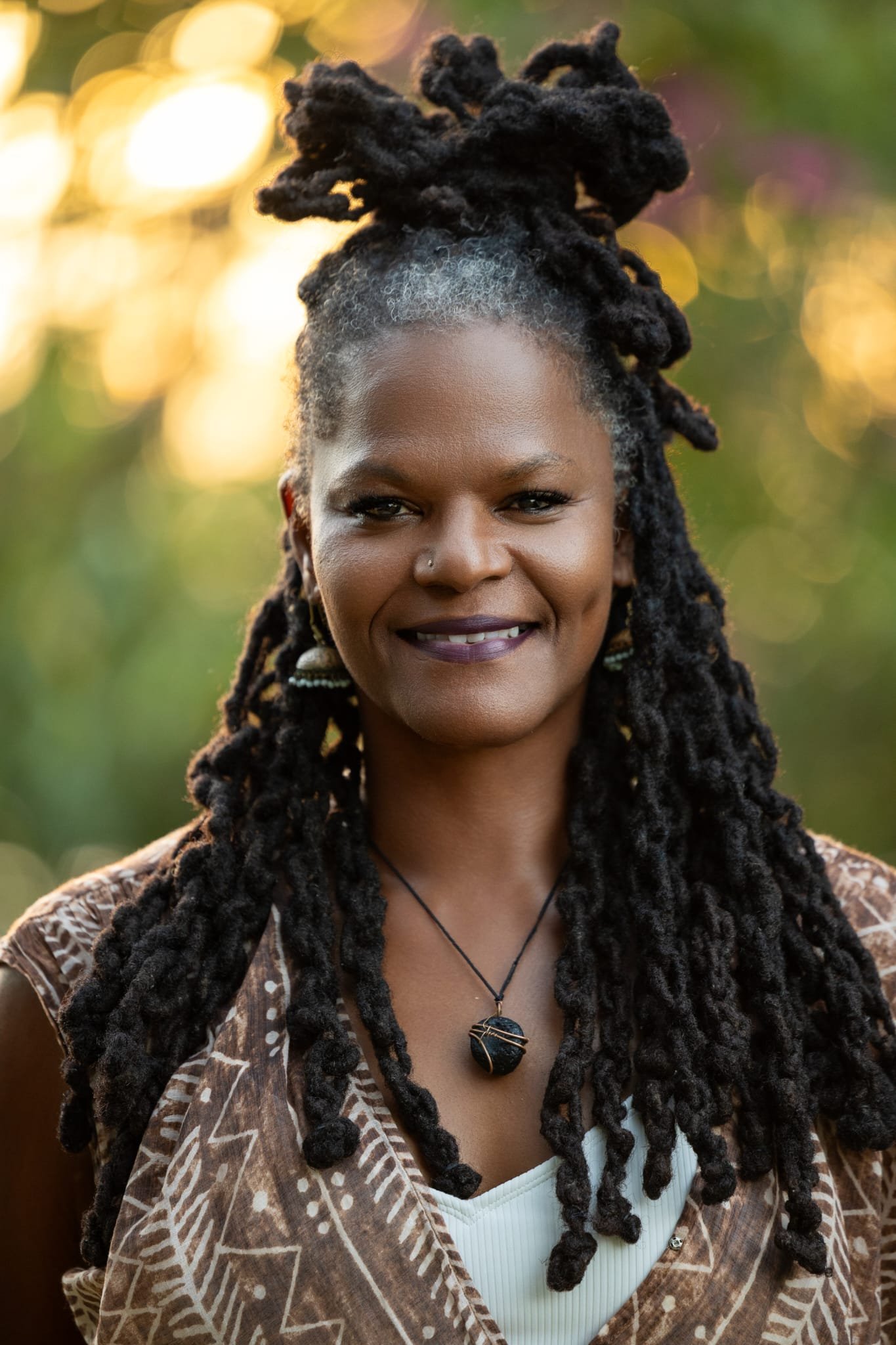
BIO
Dr. Yanique Hume is a scholar, choreographer, and practitioner of African diaspora dance — a thinker and maker whose life's work refuses the boundary between the intellectual, the artistic, and the sacred. Her scholarship moves across Caribbean Cultural Studies, African Diaspora Spiritualities and Religiosities, and Afro-Atlantic Festive and Sacred Arts, animated always by a single insistence: that the body knows, that movement remembers, and that dance is a living archive of ancestral wisdom.
Senior Lecturer in Cultural Studies and former Head of Department at the University of the West Indies, Cave Hill Campus, she brings to her scholarship a comparative depth forged across decades of fieldwork, research, and embodied practice in Jamaica, Cuba, Haiti, Suriname, and Brazil. Her research centres on Afro-Atlantic mortuary practices, African diaspora spiritualities, and the expressive cultures of the Black Atlantic — work that sits at the intersection of anthropology, performance studies, comparative religion, and critical dance practice.
She is the co-editor of Passages and Afterworlds: Anthropological Perspectives on Death and Mortuary Practices in the Caribbean (Duke University Press, 2018), Caribbean Popular Culture: Power, Politics and Performance (Ian Randle Press, 2016), and Caribbean Cultural Thought: From Plantation to Diaspora (Ian Randle Press, 2013), among other major works. Her peer-reviewed scholarship appears in Dance Research Journal, Caribbean Quarterly, and e-Misférica.
As a choreographer, Dr. Hume has created and performed works across the Caribbean, the Americas, West Africa, and Europe — from environmental performances at Virginia Keys Beach, Miami, to a commissioned choreography for the 15th Edition of the Dakar Biennale (2024). Trained in Haitian, Jamaican, and Cuban movement vocabularies, and grounded in the sacred performance traditions of the Afro-Caribbean, her creative practice is inseparable from her scholarly production. She does not study the living archive. She inhabits it.
In 2026, she was honoured with the Richard A. Long Award for Research and Creative Practice in African Diaspora Dance, granted by the Collegium of African Diaspora Dance (CADD) — a recognition that carries personal and ancestral weight. Nearly three decades ago, she sat in Richard A. Long's classroom at Emory University and encountered a framework that affirmed Black expressive culture as a vital site of knowledge production. To receive an award bearing his name is to feel the long arc of a lineage closing gently around itself.
Dr. Hume holds a PhD in Comparative Studies in Culture, History and Theory from Emory University and has been supported by fellowships from the Wenner-Gren Anthropological Foundation, the Social Science Research Council, the Ford Foundation, and the Smithsonian Institution. She is President of KOSANBA, the Scholarly Association for the Study of Haitian Vodou and African Diaspora Religions, and the vice president of the Caribbean Studies Association (CSA). Learn more